
Introduction to Esports
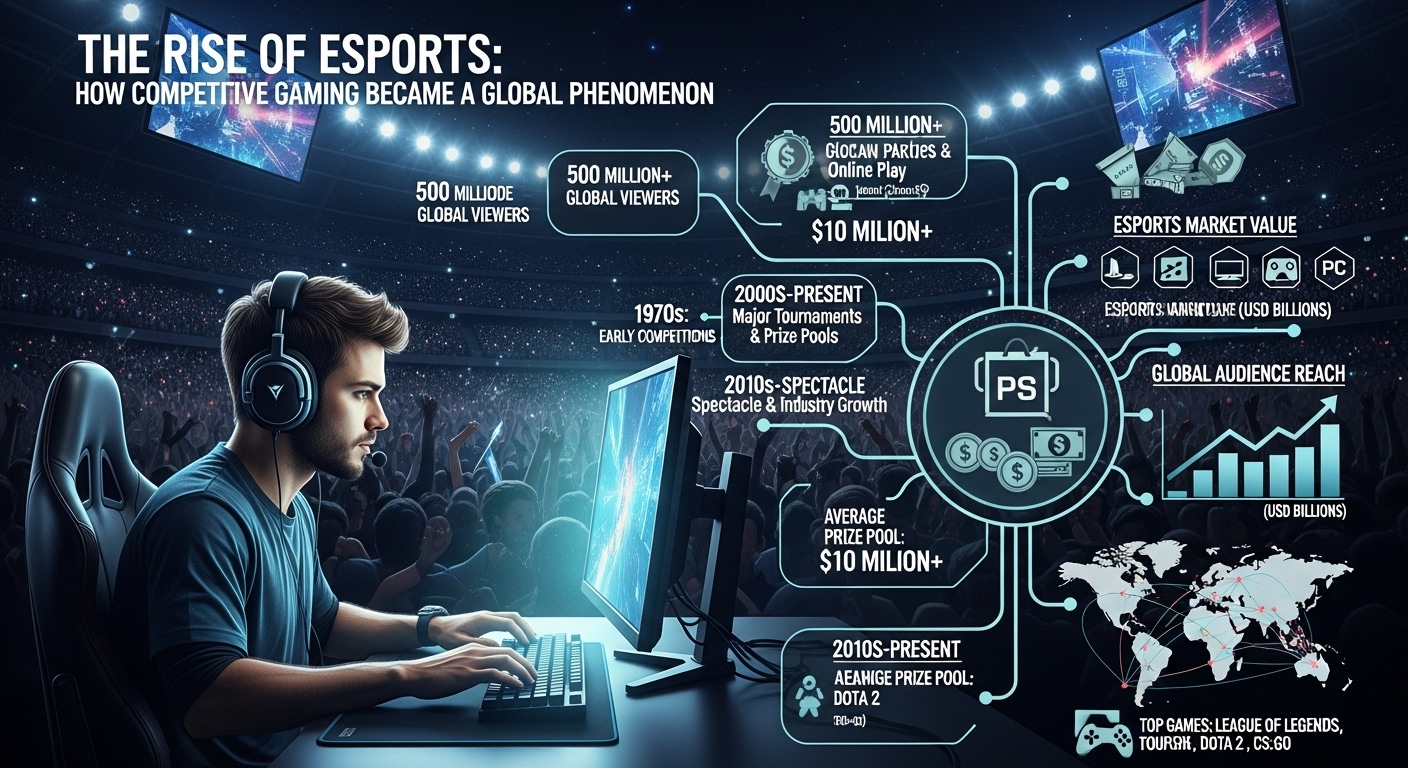
Esports, short for electronic sports, refers to organized and competitive video gaming where individuals or teams face each other in various games for fame, glory, and prize money. Over the last two decades, esports has grown from a niche pastime into a global phenomenon, attracting millions of fans and players worldwide. What was once viewed as a casual hobby is now a billion-dollar industry with international tournaments, professional players, coaches, analysts, and sponsors. The rise of esports is a reflection of how technology, entertainment, and sports have converged to create a new kind of global competition.
The Early Days of Competitive Gaming
The story of esports began long before it became a mainstream spectacle. In the 1970s and 1980s, video game competitions were small-scale events held in arcades or among friends. The first notable competitive gaming event was held in 1972 at Stanford University for the game “Spacewar!” where the prize was a year’s subscription to a magazine. As technology improved, games like “Pong,” “Pac-Man,” and “Donkey Kong” became popular, and players began to chase high scores for recognition.
The 1990s marked the true beginning of organized esports. The introduction of multiplayer games such as “Doom,” “Quake,” and “StarCraft” allowed players to compete against one another through local area networks (LANs). LAN parties became the heart of early gaming competitions, where players gathered to test their skills face-to-face. This era also witnessed the formation of the first esports organizations and leagues.
The Role of the Internet in Esports Expansion
The internet transformed gaming from a local activity into a global community. With the rise of broadband connections in the early 2000s, gamers could now play against opponents from different countries in real time. Titles like “Counter-Strike,” “Warcraft III,” and “League of Legends” flourished, creating international scenes where players from South Korea, China, Europe, and North America competed regularly.
Online streaming and digital communication made it possible for fans to watch live matches and follow their favorite teams. This accessibility was a key factor in transforming esports into a spectator sport. Just as fans gather to watch football or basketball, millions of people now tune in to watch esports tournaments online.
The Global Growth of Esports
Today, esports is a global industry worth billions of dollars. Major tournaments such as “The International” for Dota 2, the “League of Legends World Championship,” and the “Fortnite World Cup” offer prize pools that rival or surpass those of traditional sports events. Stadiums fill with tens of thousands of spectators, and millions more watch online through streaming platforms.
Esports is not limited to one region or culture. In Asia, particularly in South Korea and China, esports is treated with the same seriousness as any other professional sport. South Korea, often considered the birthplace of modern esports, has government-recognized leagues and televised matches. China has massive arenas dedicated to esports competitions and an enormous fan base. In North America and Europe, esports organizations have grown rapidly, attracting investment from traditional sports teams and major corporations.
The Professionalization of Esports
As esports evolved, it adopted the structure of traditional sports. Professional teams now have coaches, analysts, psychologists, and nutritionists to ensure that players perform at their peak. Training facilities are equipped with the latest technology to help players practice efficiently. Teams analyze opponents, review replays, and develop strategies in the same way football teams study their rivals.
Players often sign contracts that include salaries, sponsorships, and performance bonuses. Major esports organizations like Team Liquid, Fnatic, and T1 have become global brands, managing rosters across multiple games. This professional structure has helped legitimize esports as a career path, giving rise to a new generation of athletes who train not on physical fields, but on digital battlefields.
Esports Titles that Defined Generations
Several games have shaped the history and identity of esports. Titles like Counter-Strike, StarCraft, and League of Legends are more than just games; they are the foundations upon which the esports ecosystem was built.
StarCraft became a national obsession in South Korea, giving birth to professional leagues and televised matches. The Counter-Strike series defined team-based shooters and continues to dominate esports through its tactical depth and teamwork. League of Legends, launched in 2009, revolutionized the multiplayer online battle arena (MOBA) genre and became one of the most-watched esports games in the world.
Meanwhile, games like Dota 2, Overwatch, Valorant, Call of Duty, and Fortnite have all contributed to expanding esports’ reach. Each game appeals to a unique audience, yet all share the same competitive spirit that drives players to strive for excellence.
Streaming and the Rise of Gaming Celebrities
Streaming platforms played a crucial role in esports’ rise to global prominence. Platforms where fans can watch professional matches or follow their favorite streamers have made gaming accessible to everyone. Unlike traditional sports, where athletes are often distant from their fans, esports personalities engage directly with their audience through live interactions.
Streamers and content creators have become celebrities in their own right, sometimes even more popular than professional players. They bridge the gap between entertainment and competition, keeping the community vibrant and engaged. Esports fans not only watch tournaments but also learn from professionals through tutorials and streams. This accessibility has created a stronger connection between players and audiences.
Esports and Traditional Sports: A Growing Relationship
Traditional sports organizations initially dismissed esports as a passing trend, but many have now embraced it. Major sports franchises have invested in esports teams or created their own. Basketball teams, football clubs, and even Formula 1 organizations have entered the esports world to connect with younger audiences.
The International Olympic Committee has even recognized esports as a potential avenue for future events. Some regions have begun including esports in multi-sport competitions, acknowledging the skill, discipline, and teamwork involved. Although debates continue about whether esports should be classified as a sport, its competitive nature and global appeal are undeniable.
The Economic Impact of Esports
The financial aspect of esports is remarkable. Tournaments attract massive sponsorship deals from tech companies, energy drink brands, and apparel manufacturers. Advertisers see esports as a gateway to a young and digitally connected audience. In-game purchases, team merchandise, and media rights all contribute to the industry’s revenue.
Esports also provides employment opportunities beyond playing. Coaches, commentators, analysts, event organizers, and software engineers all play vital roles in the ecosystem. The growth of esports has encouraged universities to offer scholarships and degrees related to gaming, esports management, and digital media. This formalization has solidified esports as a legitimate career path.
The Role of Education in Esports Development
Educational institutions have started recognizing the potential of esports not just as entertainment but as a learning tool. Schools and universities now host esports clubs, leagues, and training programs. Students who participate in esports develop teamwork, leadership, and problem-solving skills. Many universities also offer esports scholarships to talented players, mirroring athletic programs in traditional sports.
In addition, esports education promotes STEM learning. Students interested in gaming often pursue careers in software development, game design, and computer engineering. Thus, esports has become a gateway for technological literacy and innovation.
The Social and Cultural Influence of Esports
Esports has significantly influenced modern culture. Gaming communities have created their own slang, art, fashion, and even music. Iconic gaming moments are celebrated online just like sports highlights. Esports fans follow players’ careers, wear their team jerseys, and attend conventions and tournaments.
Moreover, esports has created global friendships and communities that transcend borders. Players from different countries collaborate and compete, fostering cultural exchange. Esports also provides an inclusive environment where age, gender, or physical ability do not restrict participation.
Challenges Facing the Esports Industry
Despite its growth, esports faces several challenges. One major concern is player burnout. Professional gamers often train for long hours, leading to physical and mental fatigue. Unlike traditional athletes, esports players have shorter careers due to the intense nature of competition and rapid game updates that demand constant adaptation.
Another challenge is maintaining integrity in competition. Issues like cheating, match-fixing, and hacking have occasionally tarnished esports’ image. However, governing bodies and organizations are working hard to enforce rules, introduce anti-cheat software, and ensure fair play.
Additionally, the industry must address inclusivity and diversity. While esports is accessible to everyone, representation of women and minority groups remains low. Efforts are being made to create safer and more welcoming environments for all players.
Technological Innovations Driving Esports Forward
Technology is the backbone of esports, and continuous innovation ensures its growth. High-performance gaming hardware, faster internet speeds, and immersive experiences such as virtual and augmented reality are redefining how games are played and watched.
Artificial intelligence and data analytics now play a role in player training and strategy development. AI tools analyze gameplay to identify mistakes, improve tactics, and predict opponent behavior. Spectator experiences are also improving, with 3D replays, interactive viewing, and real-time statistics enhancing engagement.
Cloud gaming promises to make esports even more accessible by removing the need for high-end hardware. Players will be able to compete on virtually any device with a stable internet connection, broadening the player base even further.
Esports and the Future of Entertainment
Esports is more than competition; it is entertainment at its finest. Major tournaments resemble concerts or festivals, complete with music performances, light shows, and celebrity appearances. Game developers design games with esports potential in mind, creating titles that are both enjoyable to play and exciting to watch.
As the boundaries between gaming and entertainment blur, esports continues to shape media consumption habits. Young audiences prefer interactive and digital entertainment over passive television watching, and esports perfectly fits this demand. Esports documentaries, movies, and series have already begun entering mainstream culture, further expanding its influence.
The Future of Esports
Looking ahead, the future of esports appears brighter than ever. The combination of technological innovation, global participation, and passionate communities ensures continued growth. The line between esports and traditional sports will continue to fade, with more collaborations, crossovers, and shared audiences.
Virtual reality competitions, AI-driven tournaments, and mixed reality events could redefine what it means to compete in digital spaces. The expansion of 5G technology will also make mobile esports even more dominant, particularly in regions where mobile gaming is already prevalent.
Education, entertainment, and business will all continue to intersect with esports, creating new opportunities and experiences. Esports will likely become a central pillar of global youth culture, influencing fashion, media, and lifestyle in ways similar to how sports and music have done for generations.
Conclusion
Esports has evolved from a niche pastime into one of the most dynamic industries of the modern era. It embodies the spirit of competition, teamwork, and innovation while breaking down barriers between cultures and generations. What makes esports remarkable is its inclusivity and adaptability. It has united millions of people across the globe who share a passion for gaming and competition.
From small LAN parties to massive international arenas, esports has come a long way. It has proven that digital competition can inspire the same excitement, emotion, and dedication as any traditional sport. As technology continues to evolve, esports will remain at the forefront of entertainment, shaping the future of how humanity plays, watches, and connects.